
We are living through a renaissance of expression.
For the longest time, there has been a locked door in the house of creativity. You could paint with words. You could sculpt with visuals. You could design with code. But the room labeled “Music” was barred shut, accessible only to those who held the specific, heavy keys of music theory, instrument proficiency, and production engineering.
If you are like most creators, you have lived your life pressing your ear against that door. You hear the music inside your head, the swelling crescendos of a breakthrough idea, the gritty bassline of a city street at night, the ethereal hum of a memory. You can feel the soundtrack of your life and your work.
But when do you try to bring it into the real world? Silence.
Or worse, you are forced to use the “musical leftovers” of the internet: generic stock tracks that sound like elevator music for a dystopian corporate office.
This is not just a technical limitation; it is a suppression of your narrative potential. But the lock has been broken. We have entered the age of Generative Audio Alchemy, where the only instrument you need to master is your imagination.
The Great Translation Problem
Let’s diagnose the frustration we have all felt.
You are editing a video, launching a podcast, or building a brand identity. You know exactly what the “vibe” is. It needs to be hopeful but not cheesy, driving but not aggressive, nostalgic but modern.
The Old Workflow: The Search for a Needle in a Haystack
In the past, you would log onto a stock music site. You would type “Cinematic Pop.” You would get 15,000 results.
- Track 1: Too loud.
- Track 2: Too slow.
- Track 3: Sounds like a 1990s car commercial.
- Track 45: Perfect, but costs $400 to license.
You spent hours searching for something that already existed, hoping it would fit the unique shape of your idea. It was a process of compromising. You were forcing your square peg of a vision into the round hole of someone else’s art.
A Direct Encounter with the “Universal Translator”
I want to share a moment that redefined my understanding of creative control.
I am a writer by trade, not a musician. Recently, I was crafting a digital campaign for a boutique coffee brand that wanted to evoke “the feeling of a rainy Sunday morning in Kyoto.”
I tried stock music. It was a disaster. Every “Zen” track sounded like a cheap spa, and every “Lofi” track sounded like chaotic beat tape. I was frustrated because I could hear the specific sound in my head, the sound of rain on pavement, a distant jazz trumpet, and the warmth of vinyl crackles.
I decided to test the waters of the AI music generation. I didn’t have high hopes. I expected a robotic, disjointed mess.
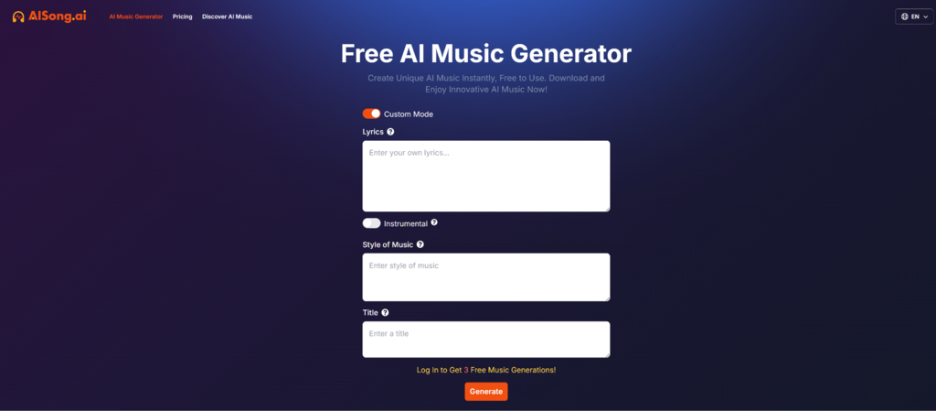
I logged into AISng.ai and treated the prompt box like a confessional booth. I didn’t use technical terms. I used emotional ones.
“A warm, intimate jazz-hop fusion. The sound of rain against a window. A lonely but comforting saxophone melody. Soft piano chords. No drums at first, then a slow, dusty beat drops in. Mood: Introspective and cozy.”
I hit enter.
The result was not just accurate; it was haunting.
The AI hadn’t just matched keywords; it had synthesized an atmosphere. The saxophone didn’t sound programmed; it sounded like it was being played in a smoky room. The rain texture was perfectly mixed behind the piano. It was the exact sonic translation of my text.
It felt like magic. But it wasn’t magic; it was the new reality of Prompt-to-Performance.
The Shift: From Consumer to Conductor
This technology fundamentally changes your role in creative hierarchy.
In the traditional model, you are a Consumer. You browse, you buy, you use it. You are at the mercy of what is available.
In this new model, you are a Conductor.
You don’t need to know how to bow to a violin or tune a kick drum. You simply need to know what you want the audience to feel. The AI acts as your session orchestra, tirelessly ready to execute your vision.
The “Co-Pilot” Philosophy
Think of this like modern aviation.
- Traditional Production: You are flying a biplane in WWI. You feel every gust of wind; you are wrestling with the stick, and if you lose focus for a second, you crash.
- AI Synthesis: You are the captain of a starship. You tell the navigation computer (the AI), “Set course for the Orion Nebula.” The computer handles math, fuel injection, and the trajectory. You simply decide the destination.
This doesn’t make you “lazy.” It makes you strategic. It frees up your mental energy to focus on the story, rather than the syntax of sound waves.
Visualizing the Leap: The Efficiency Matrix
To truly grasp the magnitude of this shift, we need to compare the “Old World” of music acquisition with the “New World” of AI synthesis. This isn’t just about speed; it’s about the integrity of the final product.
| Comparison Factor | The Stock Music Library Hunt | Hiring a Human Composer | The AISong.ai Workflow |
| The Process | Passive Searching (Listening to 100s of tracks) | Active Negotiation (Briefs, revisions, contracts) | Active Creation (Prompting & Refining) |
| Creative Control | Low (You take what you can find) | High (But dependent on budget/time) | Absolute (Your words = The output) |
| Turnaround Time | Hours of browsing | Weeks of production | Seconds of generation |
| Uniqueness | None (Others use the same tracks) | High (Bespoke) | High (Generated unique for you) |
| Cost Barrier | Moderate (Subscriptions add up) | Prohibitive ($500 – $5,000+) | Democratized (Accessible to all) |
| Emotional Match | “Close Enough” | Precise | Contextually Adaptive |
The Unfair Advantage: Contextual Intelligence
The row labeled “Emotional Match” is the game-changer.
Human language is nuanced. When you say “Heavy,” do you mean “Heavy Metal” or “Heavy Emotion”?
Traditional search engines struggle with this. If you search “Heavy,” you get Metallica.
But advanced AI engines understand context. If you type “A heavy silence after a breakup,” the AI understands the weight of the emotion, not just the genre of tag. It delivers a sound that matches the feeling, not just the keyword.
Why Your Brand Needs a Sonic Fingerprint
If you are a content creator, marketer, or business owner, you know that the internet is a war for attention.
Most brands look different. Very few brands sound different.
By relying on the same royalty-free libraries as your competitors, you are diluting your brand identity. You are wearing the same uniform as everyone else.
AI Vocal Synthesis allows you to:
- Own Your Sound: Create a signature intro/outro that exists nowhere else on earth.
- Scale Your Content: Generate 10 different variations of your theme song for different social media formats (a 15-second energetic version for TikTok, a 3-minute ambient version for YouTube).
- Hyper-Personalize: Imagine sending a client a thank-you video where the background music is a custom song in their favorite genre. That is the level of detail that wins loyalty.
The End of “I Can’t”
We often use our lack of technical skills as a shield. “I would make a film, but I don’t know lighting.” “I would write a song, but I don’t know the chords.
Those shields are being dismantled, one by one.
The ability to create professional, emotionally resonant music is no longer a skill you must spend 10 years acquiring. It is a tool you can pick up today. The friction between “Thought” and “Thing” has been reduced to zero.
The orchestra is warming up. The audience is waiting. The silence is yours to break.